
The Scale of the Jua Kali’s Sector in Kenya
According to the Economic Survey of 2025 (a report released annually by the Kenya National Bureau of Statistics), Kenya’s Jua Kali sector employed a staggering 16.7 out of 20.8 million Kenyans in 2023. This roughly equates to 83% of the nation’s employment. Judging from recent year-on-year trends, this overall share is likely to hold or increase modestly (83.6% in 2024, from 83.2% in 2021). Yet despite its undeniable importance to Kenya’s economy, the Jua Kali sector continues to face systemic challenges that limit workers’ ability to reap the full benefits of their work and maximise their potential. It is precisely these workers, like Akumu, a grocery vendor or mama mboga as they are locally known, that Lumajira aims to impact. We caught up with her before dawn on a Wednesday morning as part of Lumajira’s awareness outreach.
The Chaotic Market Hustle
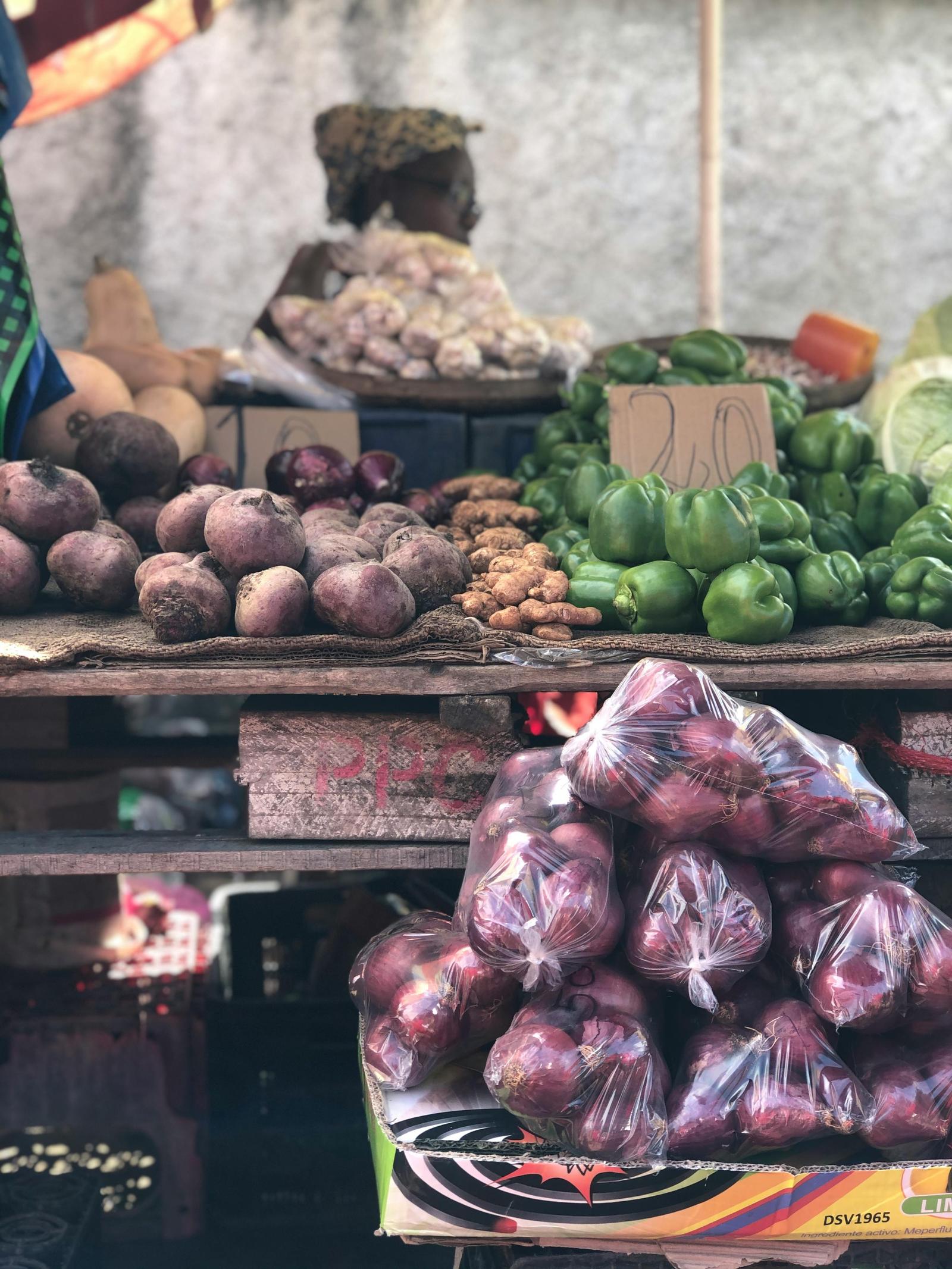
“Selling here on any market day is an extreme sport!” quips Akumu as she elbows her way past 2 men scrambling for cabbages just momentarily to be offloaded from a truck. Being the designated local ‘market day’, her sales usually double that of most other weekdays. Before the selling, however, comes the physically and mentally trying part- getting your share of the best produce. We watch her disappear into the worryingly chaotic group of vendors, all angling for the same sacks. After what seems like a cross between a wrestling and shouting match, she emerges with a triumphant grin on her face, a bucketload of cabbage in hand, and one sandal missing. “Akumu never misses!” she announces, before guiding us away to her stall. It’s a few minutes past 5 am in Rongo, and her day is just getting started.
For Akumu and millions like her, the physical toll of the work, or selling her vegetables, is nowhere near the biggest challenge she faces in making a living- she had evidently mastered that art rather gracefully. The challenges lie in the conditions around her- the poor market infrastructure, a financial system that forgets people like her, and subpar skills in areas like inventory management, and ever-lurking occupational safety risks- the high risks Lumajira seeks to address through training and policy support.
Financial Exclusion of Jua Kali Workers
Formal financial systems often exclude many informal workers, with a 2016 World Bank study reporting that 59% of informal businesses cite access to finance as their biggest obstacle, and 63.8% rate it as severe. Part of the problem lies in record-keeping, exacerbated by low literacy and skill levels among Jua Kali workers. Most informal workers lack training in business record-keeping, leading to scepticism from banks and lenders and operational inefficiencies. This is simply a skills gap, which Lumajira tackles through training and seminars.
“I have only managed to grow my stall through my chama,” Akumu says when we ask her about credit. "I have 3 different bank accounts, but I have never taken a personal business loan out of any of them. Not after what my sister went through." Her sister, a mitumba trader, she tells us, took out a loan that she struggled to repay when the Covid-19 pandemic ravaged the economy. Her supplies were affected, and she couldn't get any buyers for her remaining stock either. Faced with fewer and fewer options and increasingly relentless debt collectors, she eventually had to sell household items to settle her loan and closed down her business. Unfortunately, this remains the reality for people like her. Left with few alternatives, businesses occasionally turn to shylocks and mobile lenders who charge exorbitant rates and quickly end up closing their businesses too.
Daily Realities: Poor Infrastructure and Waste Management
We pause our questions as the market begins to fill. Traders like her, almost all of whom are her friends, set up their stalls and begin preparing for the day. We quickly find out from her that most of them have been selling here for over 10 years. They have raised their children and taken them through school on their earnings here. We observe as they go about their day, keeping each other company in the increasingly bustling market with small talk and the latest gossip, often with the mandatory laughter and cheeky high-five. None of them seemed to mind the sour vegetable odour that most of their customers complained about. The market dumpster was barely 100 metres away, and the collectors had clearly neglected their mandate for a few days. This, coupled with the sweltering heat, made for a rather unpleasant work environment. Akumu seemed to notice our discomfort and laughed pitifully.
“It only takes a few days to get used to. Our complaints to market management rarely work. We are used to the conditions. Whenever the garbage collectors come around, we cheer them sarcastically. They fail to appear more often than not.” She says.
Besides being a horrific smell to endure, the waste here could easily be put to better use through Lumajira’s eco-friendly approach. Proper and more conscious management could make the market cleaner and even improve efficiency. The rotting produce could be utilised as compost if properly separated from non-organic waste, and the plastics could well be recycled. Initiatives like these could slowly but surely improve these traders' work environment, but have largely failed to take off or started but quickly stopped. For the roadside Jua Kali workers without market-designated stalls, toilets and latrines are missing altogether. Add this to the persistent fumes and dust from unpaved roads, and the risk of disease never seems to be far off.
Lumajira’s Path to Empowerment
As we distributed pamphlets for Lumajira’s foundational training course set to begin the following week, we were surprised at the curiosity and eagerness with which Akumu and her friends received the news. “All we need to hear is that it can benefit our businesses and our families.” She said, “We need a chance like everyone else.”
This is the driving force behind Lumajira. Empowering Kenya's informal sector strengthens not only the business owners but also their families and the community, which has come to rely on various Jua Kali enterprises. Raising the floor for these workers will reduce their vulnerability to economic shocks, increase opportunities for expansion and diversification, and improve their day-to-day working conditions. What's more, these efforts are best formulated and implemented at the community level, as the challenges may be unique to different locations. A Jua Kali metal worker may face uniquely different challenges from a Mama Mboga like Akumu, who, in turn, has slightly different priorities than a miner in Kakamega. With Lumajira’s boots-on-the-ground approach to identifying specific problems, we aim to tackle these challenges with pragmatic, long-term solutions.
Lumajira’s dream is well within reach. The hard work and resilience of Jua Kali workers is half the work. What we must and will do is enable and facilitate an environment that works in favour of growth, rather than hindering it. The green shoots of rapid success are clear. Our mission is to water and nourish these promising dreams of Kenya's industrious workers.